


Cryptocurrency news plays an important role in helping investors, traders, and beginners understand the rapidly changing digital asset market. From Bitcoin price movements to Ethereum upgrades, nCrypto News Today: Latest Bitcoin, Ethereum, and Cryptocurrency Market Updates
ew blockchain projects, crypto regulations, and decentralized finance, the cryptocurrency industry continues to evolve.
As digital assets attract attention from individual investors and financial institutions, staying informed about the latest crypto news can help readers understand market trends, emerging opportunities, and potential risks.
In this guide, we explore the latest cryptocurrency market developments, the major factors influencing digital asset prices, important blockchain trends, and what beginners should know before entering the crypto market.
Latest Cryptocurrency News and Market Overview
The cryptocurrency market is known for its volatility. Prices can change rapidly in response to economic reports, investor sentiment, regulatory announcements, security incidents, and developments involving major digital assets.
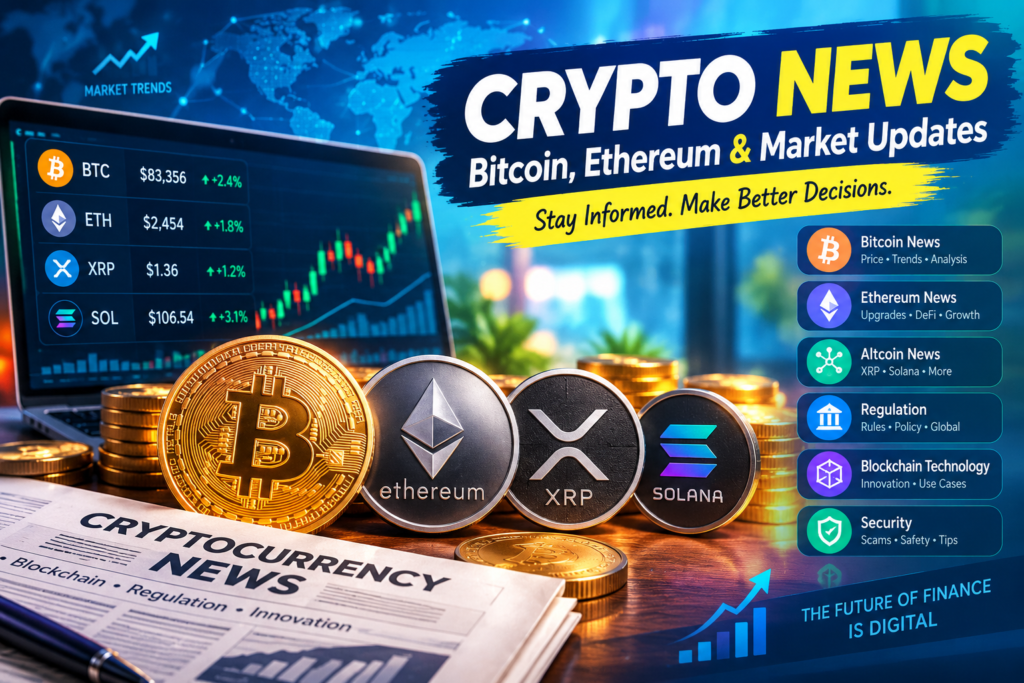
As of October 21, 2026, market coverage shows that Bitcoin and several leading altcoins have experienced renewed price movements. Investing News Network reported Bitcoin trading around $83,356, Ethereum near $2,454, XRP around $1.36, and Solana near $106.54 in its October 21 market update. These figures are snapshots, not live prices, and may change significantly.
Investors are also monitoring monetary policy, global economic conditions, cryptocurrency exchange activity, and regulatory developments to understand the direction of the market.
For the latest coverage, readers can follow The Block’s cryptocurrency market news.
1. Bitcoin News: What Is Happening in the Market?
Bitcoin (BTC) is the world’s best-known cryptocurrency and remains a major influence on overall digital asset sentiment.
Because Bitcoin has a large market capitalization, its price movements often affect the performance of other cryptocurrencies. When Bitcoin rises, some investors become more optimistic about the broader market. When it falls sharply, traders may reduce their exposure to riskier digital assets.
Factors influencing Bitcoin prices
Several factors can affect Bitcoin’s price:
- Institutional demand: Purchases and sales by investment funds and other large investors can influence market liquidity.
- Interest rates: Expectations about central bank policy can affect demand for speculative assets.
- Supply and demand: Bitcoin has a maximum supply of 21 million coins, although limited supply alone does not guarantee price appreciation.
- Market sentiment: Fear, optimism, and investor expectations can contribute to sudden price changes.
- Regulation: Government decisions and legal developments can influence access to cryptocurrency markets.
Investors should distinguish between confirmed announcements and predictions circulating on social media. A price forecast is not a guarantee of future performance.
2. Ethereum News and Blockchain Developments
Ethereum (ETH) is another major cryptocurrency. Unlike Bitcoin, which is primarily associated with digital value transfer and a decentralized monetary network, Ethereum supports smart contracts and applications that operate on its blockchain.
The Ethereum ecosystem supports decentralized finance (DeFi), blockchain-based games, digital collectibles, tokenization, and many other applications.
Why Ethereum matters
Ethereum’s development is important because improvements to its technology can affect transaction costs, network capacity, security, and the user experience.
Important areas to watch include:
- Network upgrades and scalability improvements.
- Ethereum staking and validator participation.
- Layer 2 networks designed to make transactions more efficient.
- Growth in decentralized finance applications.
- Institutional interest in Ether and Ethereum-based investment products.
Ethereum also faces competition from other smart-contract platforms, including Solana. Investors should compare the technology, adoption, security, fees, and risks of each ecosystem rather than relying on short-term price movements alone.
3. Altcoin News: XRP, Solana, and Other Cryptocurrencies
Altcoins are cryptocurrencies other than Bitcoin. Some provide smart-contract infrastructure, while others focus on payments, decentralized applications, privacy, or specialized blockchain services.
XRP
XRP is associated with the XRP Ledger, a blockchain designed to support transfers and other financial applications. News about regulation, payment infrastructure, ecosystem development, and institutional adoption can influence market sentiment toward XRP.
Solana
Solana is a blockchain platform designed for high-throughput transactions and decentralized applications. Its ecosystem includes decentralized finance, token projects, and digital asset trading.
Developments involving network performance, validator participation, application adoption, and security are important factors to monitor.
Other altcoins
Other projects may focus on decentralized computing, blockchain interoperability, stablecoins, tokenization, or artificial intelligence infrastructure.
Before investing in any altcoin, research its purpose, circulating supply, token distribution, development activity, liquidity, and security history. A low token price does not automatically make a cryptocurrency undervalued.
4. Cryptocurrency Regulation and Government Policies
Cryptocurrency regulation is one of the most important subjects in digital asset news.
Governments and financial regulators are working to determine how cryptocurrency exchanges, trading platforms, stablecoins, token issuers, and other digital asset businesses should operate.
In the United States, the Commodity Futures Trading Commission proposed a federal oversight framework on October 5, 2026, for certain cryptocurrency exchanges offering leveraged or margined spot trading. The proposal includes potential requirements related to market manipulation controls and proof of reserves.
The proposal is a regulatory development rather than a finalized, comprehensive framework for every cryptocurrency market. Its implementation and legal scope depend on the applicable rules and subsequent developments.
Readers can follow updates through Reuters’ cryptocurrency and regulatory coverage.
Why regulation matters
Clear and consistently enforced rules may help investors understand their rights and the responsibilities of service providers. However, restrictions, enforcement actions, and changes in regulatory policy can also affect market access and cryptocurrency prices.
Regulations differ between countries. Investors should understand the laws that apply to their location, particularly those concerning exchanges, taxation, reporting, and cross-border transactions.
5. Institutional Adoption of Cryptocurrency
Institutional adoption refers to the growing participation of organizations such as banks, investment funds, asset managers, and financial technology companies in digital asset markets.
Institutional involvement can take several forms:
- Cryptocurrency investment products.
- Digital asset custody services.
- Blockchain-based settlement systems.
- Tokenized financial assets.
- Stablecoin infrastructure.
- Research and development involving distributed ledger technology.
For example, Reuters reported on October 16, 2026, that Deutsche Bank was preparing to introduce digital asset custody services, initially focusing on major cryptocurrencies such as Bitcoin and Ether, with plans to expand its services over time.
Institutional adoption may support market infrastructure and accessibility, but it does not eliminate cryptocurrency volatility or guarantee higher prices.
6. Stablecoins and Decentralized Finance
Stablecoins are digital tokens designed to maintain a relatively stable value, often by referencing a currency such as the US dollar.
They are used for cryptocurrency trading, digital payments, transfers, and participation in decentralized finance.
Popular stablecoins include USDT and USDC. Their stability depends on factors such as reserve quality, redemption arrangements, issuer operations, liquidity, and regulatory oversight.
Decentralized finance, commonly called DeFi, refers to blockchain-based applications that provide financial services through smart contracts. These services may include lending, borrowing, trading, and liquidity provision.
Although DeFi can offer new ways to access financial services, it also introduces risks. Smart-contract vulnerabilities, liquidity shortages, scams, collateral liquidations, and protocol failures can cause substantial losses.
A stablecoin should not automatically be treated as equivalent to insured bank deposits or risk-free cash.
7. Blockchain Technology Beyond Cryptocurrency
Blockchain technology is being explored for applications beyond buying and selling digital currencies.
Potential use cases include:
- Supply chain management: Recording and tracking product movements.
- Digital identity: Supporting systems for verifying selected identity information.
- Tokenization: Representing certain financial or physical assets digitally.
- International payments: Exploring new methods of transferring value across borders.
- Recordkeeping: Maintaining shared records between participating organizations.
However, not every blockchain project delivers practical benefits. Organizations must consider costs, privacy, governance, scalability, security, and whether a conventional database would be more appropriate.
The long-term impact of blockchain technology will depend on real-world adoption, technical reliability, and economic value rather than publicity alone.
8. Cryptocurrency Security: Scams and Investor Protection
Security remains a major concern in the cryptocurrency industry. Transactions may be difficult or impossible to reverse, and losing access to a wallet can mean permanently losing the assets stored in it.
Common threats include phishing websites, fake investment platforms, fraudulent giveaways, impersonation scams, malicious wallet approvals, and fake cryptocurrency tokens.
How to protect your crypto assets
- Use strong authentication: Protect exchange accounts with unique passwords and multifactor authentication.
- Verify website addresses: Avoid links from unsolicited messages and advertisements that imitate legitimate services.
- Protect your recovery phrase: Never share your wallet’s seed phrase or private keys with another person.
- Research platforms carefully: Check company information, withdrawal policies, security practices, and applicable regulatory status.
- Be suspicious of guaranteed profits: No legitimate investment can guarantee unusually high returns without risk.
- Test transfers cautiously: When appropriate, verify the destination address and consider a small test transaction before transferring a large amount.
- Keep devices secure: Install software updates and avoid downloading wallet applications from unverified sources.
In October 2026, Reuters also reported renewed US government attention to overseas cryptocurrency investment scams and fraudulent websites. This is a reminder that security awareness is essential for both new and experienced users.
9. How to Follow Crypto News Effectively
Following cryptocurrency news can help readers understand market developments, but consuming more headlines does not necessarily lead to better decisions.
A practical approach is to use a combination of reliable reporting, official announcements, and independent research.
Recommended sources for cryptocurrency news
- Reuters: Business news, regulation, institutional activity, and major market developments.
- The Block: Cryptocurrency markets, digital asset businesses, and industry analysis.
- CoinDesk: Digital asset reporting, blockchain developments, and market commentary.
- Official project websites: Technical announcements, network upgrades, and project documentation.
- Regulatory websites: Official rules, warnings, enforcement announcements, and policy documents.
Always check the publication date and original source. An old headline can circulate again on social media and create a misleading impression that the event is new.
It is also useful to distinguish factual reporting from sponsored content, affiliate marketing, and opinion-based price predictions.
10. Cryptocurrency Market Trends to Watch
Several themes may influence cryptocurrency markets in the coming months. These are areas to monitor, not predictions that prices will necessarily rise.
Institutional investment
Watch for changes in investment product flows, custody services, and participation by financial institutions. Institutional interest can influence demand, but withdrawals can also create selling pressure.
Regulatory clarity
New legislation, regulatory proposals, court decisions, and enforcement actions may affect cryptocurrency businesses and investors.
Network adoption
Growth in real transactions, active applications, developer participation, and useful blockchain services can provide more meaningful information than social media popularity alone.
Stablecoin development
Changes in stablecoin regulation, payment adoption, reserves, and redemption arrangements may affect the wider digital asset ecosystem.
Security and market integrity
Exchange failures, hacks, market manipulation, and fraud can affect confidence. Proof-of-reserves disclosures may offer useful information but do not, by themselves, establish a company’s complete financial health.
Global economic conditions
Inflation, interest rates, employment data, geopolitical developments, and changes in investor risk appetite can influence cryptocurrency prices alongside digital asset-specific news.
Is Cryptocurrency a Good Investment?
Cryptocurrency may appeal to people interested in digital assets and blockchain technology, but it is a high-risk asset class.
Prices can experience substantial declines, and some projects may fail completely. Even widely used cryptocurrencies can experience prolonged periods of volatility.
Before investing, consider your financial circumstances, investment horizon, tolerance for losses, and the legal and tax rules that apply to you.
A sensible research process includes understanding the project, examining liquidity and token supply, evaluating security risks, and avoiding decisions based entirely on online hype.
Never invest money you cannot afford to lose, and do not interpret a news article as a personal recommendation to buy or sell a cryptocurrency.
Conclusion
Crypto news helps readers understand the developments shaping Bitcoin, Ethereum, altcoins, blockchain technology, regulation, and digital finance. By following credible sources and checking original announcements, investors can make better-informed decisions and avoid common misinformation.
The cryptocurrency market will continue to evolve as technology develops, regulations change, and new financial applications emerge. However, adoption and innovation do not remove the risks associated with digital assets.
Whether you are a beginner learning about Bitcoin or an experienced market observer, focus on verified information, independent research, and security. A balanced understanding of both opportunities and risks is more valuable than following every price prediction or trending token.
Disclaimer: This article is for educational and informational purposes only. It does not constitute financial, investment, legal, or tax advice. Cryptocurrency investments involve significant risk, including the possible loss of your entire investment.