Enterprise Software Product Maturity Indicators: A Practical Framework for Measuring Business Readiness
Harry October 27, 2026 0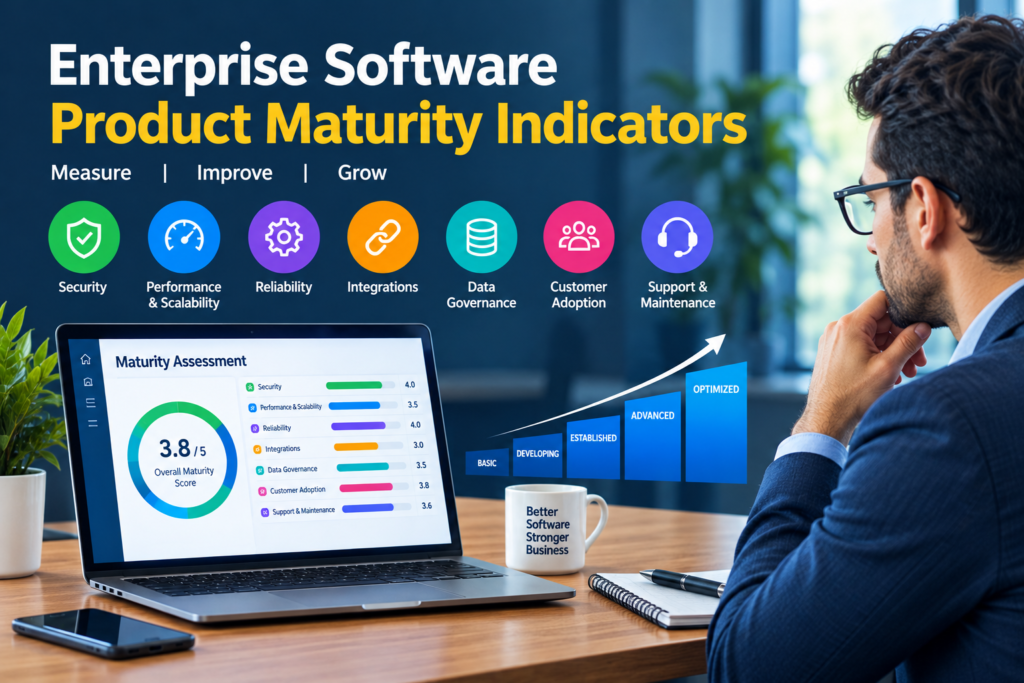
Enterprise Software Product Maturity Indicators valwriting.org
Enterprise software can look successful on the surface while hiding problems that become expensive as the business grows. A product may have paying customers, a modern interface, and a long list of features, yet still struggle when a large company requests stronger security, complex integrations, or reliable service during peak demand.
This is why enterprise software product maturity indicators deserve attention before a company expands its customer base or makes major technology investments.
These indicators help product leaders evaluate whether software is ready to support real business operations. They examine the evidence behind product quality, operational reliability, security, maintainability, customer outcomes, and the ability to handle change.
However, maturity is not a single number. A product can be strong in performance but weak in recovery planning. It can offer excellent functionality but lack the documentation required by enterprise IT teams. One serious weakness may matter more than several positive scores.
The most useful assessment therefore asks three questions:
- Can the product perform its intended tasks consistently?
- Can the organization operate, secure, and maintain it as requirements change?
- Is there evidence that the product meets the needs of its intended customers?
This guide presents a practical framework for answering those questions, identifying readiness gaps, and building an improvement plan based on measurable evidence.
What Do Enterprise Software Product Maturity Indicators Measure?
Enterprise software product maturity indicators are observable measures used to evaluate how well a software product meets its technical, operational, and business requirements.
They help distinguish a product that simply works from one that can be maintained, supported, and improved in a demanding business environment.
For example, a product may pass its initial functional tests but fail when several departments access the same reporting system. Another product may perform well but require developers to manually repair data after every failed integration.
Both situations reveal gaps that ordinary feature reviews might miss.
A useful maturity assessment covers four connected areas.
Product quality
Product quality concerns whether the software performs the functions customers need, provides a usable experience, and behaves consistently under expected conditions.
Operational readiness
Operational readiness measures whether teams can monitor the product, manage incidents, restore service, and release changes without creating unnecessary disruption.
Enterprise suitability
Enterprise suitability includes security, access management, integrations, documentation, governance, and the ability to meet relevant customer requirements.
Sustainable development
Sustainable development concerns whether the product team can maintain existing functionality, respond to changing needs, and improve the software without accumulating unmanageable technical problems.
These areas overlap, but each reveals a different part of product maturity.
For a recognized reference point, the ISO/IEC 25010 software quality model describes quality characteristics including reliability, security, usability, maintainability, compatibility, and performance efficiency.
Organizations can use such established quality concepts alongside their own business requirements instead of relying entirely on an informal maturity score.
The Seven Most Useful Enterprise Software Product Maturity Indicators
Rather than measuring every available metric, start with indicators that reveal whether the product can meet its core responsibilities.
1. Critical Workflow Reliability
A software product should be evaluated by how reliably it completes important business tasks, not only by whether its servers are online.
Consider an enterprise invoicing platform. Its homepage might load successfully while users are unable to generate invoices or synchronize payment records.
A basic availability report could miss the practical impact of this failure.
Measure the reliability of important user journeys, such as creating a transaction, approving a request, exporting a report, or completing an integration.
Useful evidence includes:
- Successful completion rates for critical workflows.
- Frequency of incidents affecting essential functions.
- Time needed to restore normal operation.
- Number of recurring production problems.
- Performance against agreed service objectives.
The key question is whether customers can complete the tasks for which they purchased the product.
2. Capacity Headroom and Growth Tolerance
Enterprise readiness requires more than acceptable performance under today’s workload. Teams also need to understand what happens when demand increases.
A product may serve 500 users comfortably but slow down when several thousand users generate reports at the same time.
Capacity headroom measures the distance between current demand and the point at which performance or reliability becomes unacceptable.
Teams should examine database load, memory consumption, processing capacity, storage growth, and external service limits.
Load testing should represent realistic customer behavior rather than simply generating large numbers of artificial requests.
For example, a business application might need to handle a Monday morning login surge, bulk data imports, and simultaneous reporting requests.
A mature product team can explain its expected operating limits, identify likely bottlenecks, and demonstrate how additional capacity can be introduced.
3. Change Safety and Recovery
Enterprise software must evolve without putting essential business operations at unnecessary risk.
Every update can introduce defects, affect integrations, or change how existing features behave. Product maturity therefore depends on how well the team controls and reverses changes.
Useful indicators include deployment failure rates, rollback time, regression test results, and the frequency of incidents caused by releases.
Teams should also test what happens when a deployment fails halfway through or an external dependency becomes unavailable.
A product with a repeatable recovery process is generally easier to operate than one that depends on a developer manually fixing production problems.
The goal is not to eliminate every failure. It is to reduce avoidable failures and make recovery predictable.
4. Security and Data Boundary Protection
Enterprise customers need evidence that their information is protected and that access is limited to authorized people and systems.
The appropriate controls depend on the product and its customers, but common considerations include authentication, permissions, encryption, audit records, vulnerability management, and secure software updates.
For multi tenant software, tenant isolation deserves particular attention. Each customer must remain separated from other customers’ private data.
A useful assessment should examine actual behavior rather than simply confirm that a security policy exists.
For example, test whether a user with limited permissions can access restricted records through an API, exported report, or unexpected application route.
Documented test results, remediation records, and appropriate independent assessments provide stronger evidence than unsupported security claims.
5. Integration Resilience
Enterprise applications often depend on multiple systems exchanging information. These connections may involve identity providers, finance platforms, customer databases, data warehouses, and internal APIs.
An integration that works under normal conditions may still fail when a connected service is slow, unavailable, or returns unexpected information.
Integration maturity measures whether the product can handle these situations safely.
Important checks include API versioning, authentication, data validation, error handling, retry behavior, and monitoring of failed synchronization.
Teams should also identify what happens when the same request is submitted twice or when a connection fails after only part of a transaction has completed.
A mature product has clear integration documentation and predictable behavior when dependencies do not work as expected.
6. Maintainability and Knowledge Independence
A product becomes difficult to scale when routine maintenance depends on a small number of people who understand undocumented parts of the system.
Maintainability measures how easily developers can investigate defects, modify functionality, test changes, and understand existing behavior.
Knowledge independence examines whether the team can operate the product when a key developer is unavailable.
Useful evidence includes automated tests, architecture documentation, code review practices, dependency inventories, and the time required to complete routine maintenance tasks.
A practical test is to ask a developer unfamiliar with one part of the product to investigate a documented issue using the available tools and instructions.
If the task consistently requires extensive help from one individual, the product may have a knowledge management problem.
7. Customer Outcome Consistency
Enterprise product maturity also depends on whether customers achieve the outcomes they expect.
A product can be technically reliable but still fail to deliver value if users cannot understand its workflows or integrate it into daily operations.
Measure outcomes relevant to the product’s purpose.
For a procurement platform, this might include successful purchase order completion. For a reporting application, it might include the time needed to produce accurate reports. For employee software, it could involve successful completion of onboarding tasks.
Supporting metrics may include activation, retention, support requests, task completion, and customer feedback.
Avoid relying on login counts alone. Frequent usage does not necessarily mean that customers are achieving their goals.
A Risk Weighted Method for Measuring Software Product Maturity
A simple average score can hide serious weaknesses. A better approach considers both the quality of each area and the consequences of failure.
The following framework is a practical assessment method, not an official industry standard.
Step 1: Define the Required Outcomes
Write down the most important outcomes the product must deliver.
Examples include:
- Complete critical transactions accurately.
- Protect customer information.
- Meet defined performance requirements.
- Recover within agreed business limits.
- Integrate with required enterprise systems.
- Support maintenance without repeated disruption.
These outcomes should reflect actual customer and business needs.
Step 2: Rate Each Indicator
Use a five level scale to describe the current state.
| Score | Level | Evidence |
|---|---|---|
| 1 | Uncontrolled | Major risks are unknown or addressed only after problems occur. |
| 2 | Basic | Some controls exist, but important gaps remain. |
| 3 | Established | Requirements and processes are documented and used consistently. |
| 4 | Measured | Performance is monitored and controls are tested regularly. |
| 5 | Adaptive | Evidence and feedback drive continuous improvement. |
Each rating should have supporting evidence. If the team has not tested its recovery plan, it should not assign a high score based only on having a written procedure.
Step 3: Assign Risk Weights
Not every indicator has the same importance for every product.
For example, security and data integrity may carry especially high weights for financial software. Performance and recovery may be critical for applications supporting time sensitive operations.
Assign weights that total 100%.
Multiply each indicator’s score by its weight, then add the results.
For example, suppose a product receives these scores:
| Indicator | Score | Weight |
|---|---|---|
| Reliability | 4 | 25% |
| Security | 3 | 30% |
| Scalability | 3 | 20% |
| Integrations | 4 | 15% |
| Maintainability | 4 | 10% |
The weighted result is:
[
(4 \times 0.25)+(3 \times 0.30)+(3 \times 0.20)+(4 \times 0.15)+(4 \times 0.10)=3.50
]
The result is 3.5 out of 5.
This indicates a reasonable overall position across the selected areas, but it does not prove that the product is enterprise ready. Security remains an area requiring review, and the team must determine whether a score of 3 meets the actual security requirements.
Step 4: Establish Readiness Gates
Some requirements should be treated as mandatory rather than averaged into a general score.
Examples include acceptable access controls, tested recovery procedures, critical workflow reliability, and contractual compliance requirements.
If a product fails a mandatory requirement, the team should address that gap before making a readiness decision for the relevant deployment.
This approach prevents strong performance in one area from concealing an unacceptable weakness in another.
How to Turn Maturity Indicators Into an Improvement Roadmap
An assessment is useful only when it leads to action.
After scoring the product, divide the findings into three groups.
Immediate risk reduction
Address problems that could expose customer data, interrupt essential business operations, or violate important contractual requirements.
Examples include missing access restrictions, unreliable backups, and recurring failures in critical transactions.
Operational improvement
Focus on issues that increase maintenance costs or make service delivery unpredictable.
Examples include incomplete monitoring, manual deployment steps, recurring support problems, and missing recovery tests.
Long term product development
Address improvements that support future customer needs and sustainable growth.
Examples include better integration capabilities, architecture improvements, expanded automated testing, and clearer product documentation.
For every action, define an owner, a deadline, a measurable result, and the evidence required to confirm completion.
A goal such as “improve scalability” is too broad. A stronger goal identifies the expected workload, acceptable response time, and test conditions.
Review progress regularly and repeat the relevant assessments after major changes.
Practical Example: Preparing a Business Application for Larger Customers
Consider a fictional company that sells workflow software to small businesses. It wants to enter the enterprise market.
The product already has paying customers and positive feedback, but large prospects ask for stronger access controls, reliable integrations, and documented recovery procedures.
The company evaluates the product and discovers three weaknesses.
First, the application slows down during large imports. Second, its API documentation does not explain version changes clearly. Third, the team has backups but has not tested a complete recovery under realistic conditions.
The company decides not to solve every problem at once.
It first tests and improves recovery procedures because data loss would have serious consequences. It then establishes realistic load tests and fixes the import bottlenecks. Finally, it improves API documentation and introduces a clear versioning policy.
The team measures progress using recovery test results, import completion times, integration failures, and customer feedback.
This example illustrates an important principle: maturity improves when teams connect observed weaknesses to specific actions and measurable results.
Adding more features would not have solved the problems that were preventing enterprise adoption.
Common Mistakes That Reduce the Value of Maturity Assessments
Focusing on Feature Quantity
A long feature list does not prove that a product can meet demanding business requirements. Evaluate whether important functions work consistently and safely.
Treating Documentation as Proof of Capability
Written procedures are useful, but they need to reflect actual behavior. Test recovery, access controls, and deployment processes rather than assuming that documented procedures work.
Using One Score for Every Customer
Different customers have different risk profiles. A product suitable for a small company may require additional controls before it can support a regulated enterprise.
Ignoring Operational Costs
A product may perform well while requiring excessive manual work to deploy, maintain, or support. Include these costs in the assessment.
Assessing Maturity Only Before Launch
Maturity changes as usage grows, dependencies change, and new features are introduced. Review important indicators throughout the product lifecycle.
Treating Maturity as a Marketing Claim
Claims such as enterprise ready should be supported by clear evidence, defined limits, and relevant customer requirements. A high internal score is not a substitute for independent verification where it is needed.
How Established Frameworks Can Support the Assessment
Organizations do not need to create every assessment method from scratch.
The ISO/IEC 25010 quality model offers a structured vocabulary for discussing software quality.
The OWASP Software Assurance Maturity Model provides guidance for assessing and improving software security practices across governance, design, implementation, verification, and operations.
These resources address different aspects of software quality and security. They can complement an organization specific product maturity assessment, but they should not be presented as interchangeable certifications.
Choose the framework that fits the product’s risks, customer expectations, and available resources.
Frequently Asked Questions
What are enterprise software product maturity indicators?
They are measurable signs used to evaluate software quality, reliability, security, maintainability, integrations, customer outcomes, and readiness for demanding business use.
Which indicators should be assessed first?
Start with the product’s most critical business functions, security requirements, recovery capabilities, and performance under expected workloads. The order should reflect the consequences of failure.
Can software maturity be measured with a score?
Yes. A weighted score can help compare results over time, but it should be supported by evidence and combined with mandatory readiness requirements. No universal score guarantees enterprise readiness.
How often should maturity be reviewed?
Review relevant indicators after major product changes, significant increases in workload, new security requirements, or entry into a new customer segment. Periodic reviews can also help track improvements.
What is the difference between product maturity and software development maturity?
Product maturity focuses on whether the software meets its intended quality and business requirements. Development maturity focuses on how consistently the organization builds, tests, releases, and maintains software. Both influence product success, but they measure different things.
Does enterprise software need every advanced feature?
No. Maturity means that the product consistently meets its intended requirements and can be maintained responsibly. A focused product can be mature without offering every available feature.
Conclusion
Enterprise software product maturity indicators help businesses evaluate whether their software is prepared for larger workloads, more demanding customers, and greater operational responsibility.
The strongest assessment looks beyond features and general performance. It examines critical workflows, capacity limits, security controls, change safety, integration resilience, maintainability, and customer outcomes.
A practical approach combines measurable indicators with risk based priorities and mandatory readiness checks. Teams can then focus their resources on the weaknesses that matter most.
The ultimate goal is not to achieve a perfect score. It is to build software that performs reliably, protects customer interests, supports business needs, and can continue improving as those needs change.