Tech
Top Uses of Aerospace Fittings in Modern Flight Systems

Key Takeaways
- Aerospace fittings are crucial for ensuring the safety and efficiency of modern aircraft.
- They are utilized in various systems, including hydraulics, fuel lines, and structural assemblies.
- Advancements in materials and manufacturing techniques have enhanced the performance of these fittings.
The Role of Aerospace Fittings in Flight Safety
Ensuring safe and reliable operation of aircraft requires precision-engineered components at every turn. At the core of these components are aerospace fittings, which serve as vital connectors between critical subsystems. These fittings must provide airtight and pressure-resistant seals under extreme thermal and mechanical stress to help keep all parts performing optimally. As the complexity of modern aircraft increases, companies often rely on top fastener distributors to source fittings that meet rigorous safety requirements. Each flight subjects an aircraft to significant pressure changes, engine vibrations, turbulence, and drastic temperature variations. If aerospace fittings were to fail under such conditions, the consequences could be catastrophic, making their reliability a cornerstone of flight safety. As a result, these components are engineered and tested to exceed typical industry standards far.
Key Applications of Aerospace Fittings
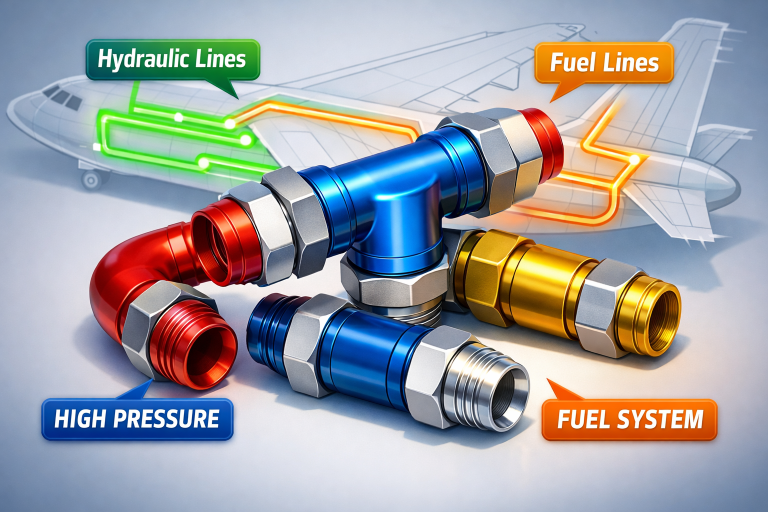
Aerospace fittings can be found throughout the airframe, engine bay, and cabin, performing roles both visible and hidden. Their most crucial applications include hydraulic systems, fuel lines, and structural assemblies.
- Hydraulic Systems: Without secure, leak-proof fittings, the hydraulic fluid powering flight control surfaces, landing gear, and brakes would never reach their destination. High-grade fittings in these systems maintain pressure, prevent fluid contamination, and endure repeated high-load cycles.
- Fuel Lines: Engine reliability and fuel economy depend on secure connections. Fittings in fuel systems must prevent leaks and resist corrosion from exposure to aviation fuel, all while keeping weight to a minimum.
- Structural Assemblies: Many structural elements of an aircraft are joined with precision fittings that add to the integrity of the airframe. These fittings absorb dynamic loads and transmit force, ensuring that the aircraft maintains its strength even under maximum stress.
Material Innovations Enhancing Performance
The constant drive for lighter and more fuel-efficient aircraft has accelerated research into advanced materials for aerospace fittings. Stainless steel remains a popular choice for its balance of durability and corrosion resistance. However, for maximum weight savings, aircraft manufacturers increasingly turn to titanium and high-performance aluminum alloys.
Titanium is especially valuable because it boasts tremendous strength at nearly half the weight of steel and is highly resistant to oxidation. Meanwhile, enhanced aluminum alloys offer improved strength-to-weight ratios through the addition of trace elements and unique fabrication techniques.

Quality Assurance and Testing Protocols
Every aerospace fitting must pass rigorous quality assurance procedures. Manufacturers simulate the harshest flight conditions through pressure cycling, thermal shock, and vibration testing. These tests ensure that fittings won’t deform, leak, or break under the operational realities of flight. For inclusion aboard any commercial or military aircraft, fittings must comply with international standards, such as those set by the American Society for Testing and Materials (ASTM) and the International Organization for Standardization (ISO). These measures ensure only the best-performing components enter service, providing peace of mind for manufacturers and operators alike. Further, traceability protocols require that every fitting can be tracked from raw material to installation, reinforcing accountability and safety.
Installation Best Practices
The longevity and reliability of aerospace fittings depend as much on installation practices as on the quality of the fittings themselves. Maintenance personnel are instructed to use new seals and gaskets for each fitting, thereby eliminating the risk of leaks from worn parts. Applying the correct torque is equally vital, as overtightening or under-tightening can damage threads or create weak points. After installation, technicians must run comprehensive leak and pressure tests. Only after passing these tests can a fitting be deemed airworthy and ready for service. These steps ensure that every connection meets the high safety standards set for aviation operations.
Regulatory Standards and Compliance
Agencies such as the Federal Aviation Administration (FAA) and the European Union Aviation Safety Agency (EASA) have comprehensive regulations governing aerospace fittings. These regulations mandate full traceability of materials and batch production, detailed component marking, and the retention of pressure test documentation for inspection. Such robust oversight ensures all fittings, regardless of application, meet minimum performance and documentation requirements. This compliance is not only a legal obligation but also contributes to the industry’s enviable safety reputation.
Emerging Technologies and Future Trends
Aerospace fittings continue to evolve as sensor technology and manufacturing advance. Smart fittings embedded with micro-sensors can now provide real-time feedback on stress, temperature, or vibration. This data enables predictive maintenance, allowing crews to address potential issues before they lead to failures. Additive manufacturing, commonly known as 3D printing, is also beginning to reshape how intricate fitting designs are produced. Using 3D printing, manufacturers can eliminate excess material, producing lightweight, customized fittings that were previously impossible with traditional machining. As technology advances, expect to see even greater use of digital design and real-time monitoring to boost reliability and safety in flight systems further.
Conclusion
Aerospace fittings may seem like minor components, but their impact on safety and performance is profound. Through ongoing innovation in materials, stringent quality controls, and strict regulatory oversight, these fittings enable today’s aircraft to fly farther, faster, and more safely than ever. As technology and expectations in modern aviation continue to rise, so too will the sophistication and importance of aerospace fittings across every flight system.