Connect with us

Lifestyle

Wander Northern Georgia: Activities Guide

Published

on

Wander Northern Georgia: Activities Guide

North Georgia is one of the most captivating and underrated destinations in the American Southeast. Just a short drive from the bustling hub of Atlanta, the region unfolds into a completely different world of ancient mountains, rushing waterfalls, vibrant small towns, and a rich history that predates the California Gold Rush. Whether you are seeking heart-pounding outdoor adventures, a deep dive into American heritage, or a serene escape into wine country, North Georgia offers a wealth of experiences.

🗺️ A Region of Ancient Beauty and Rugged Terrain

The heart of North Georgia is the Blue Ridge Mountains, a province of the larger Appalachian range. These mountains are among the oldest in the United States, estimated to be over 1 billion years old. The Cherokee people who lived here called them Sah-ka-na’-ga, meaning “Blue Smoke Mountains,” a reference to the bluish haze that often settles over their peaks.

The region’s rugged landscape is defined by its rolling, densely forested hillsides, deep gorges, and a “plethora of rivers and streams”. Much of this natural beauty is protected within the 750,000-acre Chattahoochee National Forest, providing a vast playground for nature lovers. For those seeking the state’s highest point, Brasstown Bald rises to 4,784 feet, where on a clear day, an observation deck provides stunning 360-degree views that can stretch across four states.

⛰️ An Outdoor Playground for Every Season

The region is a premier destination for outdoor activities, with opportunities for everyone from casual walkers to expert rafters.

  • The Start of the Appalachian Trail: North Georgia is home to the southern terminus of the legendary 2,175-mile Appalachian Trail. The trail begins at Springer Mountain, located in Fannin County. An 8.5-mile approach trail from Amicalola Falls State Park leads to the summit, making it a popular starting point for “thru-hikers” embarking on their epic journey north.
  • World-Class Hiking: Beyond the AT, the region boasts thousands of miles of trails. Challenging hikes include the trek up Blood Mountain, the highest point on the Georgia section of the AT, while more family-friendly options are found in Unicoi State Park near Helen. The Richard B. Russell Scenic Parkway is a 40-mile winding road that offers many trailheads, scenic overlooks like Hog Pen Gap, and is particularly breathtaking during the fall foliage season.
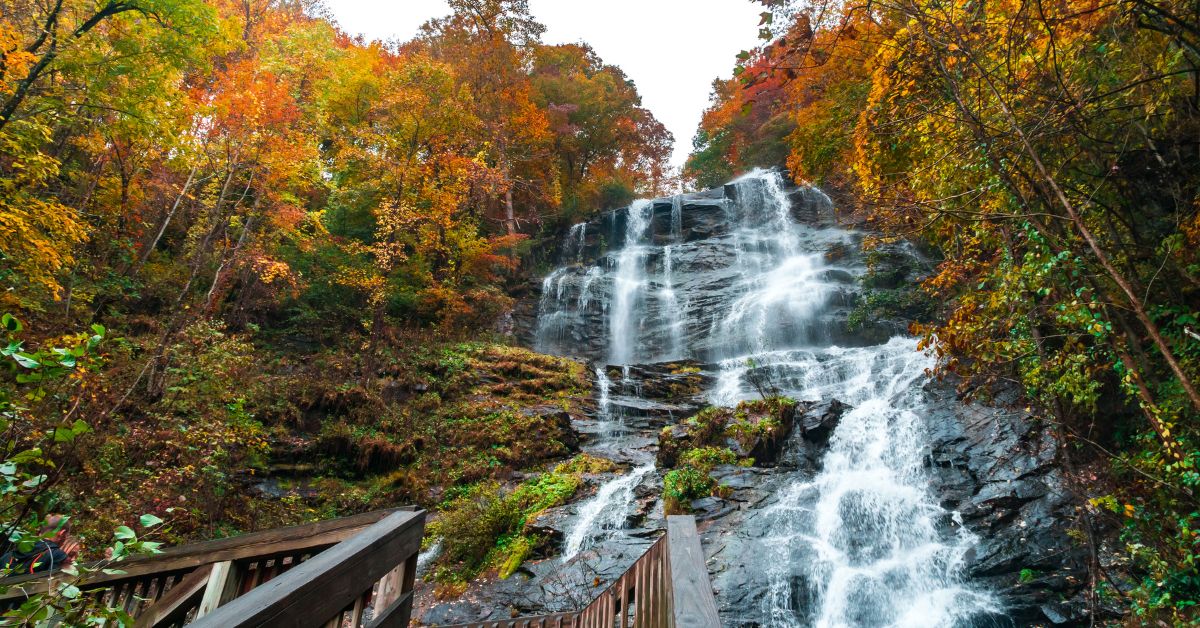
  • Spectacular Waterfalls: North Georgia is famous for its cascading waterfalls. The crown jewel is Amicalola Falls, the tallest waterfall in Georgia, which plunges 729 feet. Its name is derived from the Cherokee word for “tumbling waters”. Other iconic falls include the twin cascades of Anna Ruby Falls near Helen and the deep gorge at Tallulah Gorge State Park, one of the deepest canyons in the eastern U.S. .
  • Thrills on the Water: For those seeking adventure, the region’s rivers provide an adrenaline rush. The Chattooga River, a designated Wild and Scenic River, offers whitewater rafting with Class III and IV rapids. The Ocoee River is another premier destination for whitewater enthusiasts. For a more relaxed experience, tubing down the Chattahoochee River through the town of Helen is a favorite summer pastime for families.

🏘️ Charming Towns, Each with a Distinct Personality

The towns of North Georgia are destinations in their own right, each with a unique character and a vibrant downtown.

  • Dahlonega: The “Heart of Georgia Wine Country”, Dahlonega is famous for being the site of the first major U.S. Gold Rush in 1828, decades before the famous California strike. Today, visitors can explore the Dahlonega Gold Museum in the historic 1836 courthouse and tour the underground tunnels of the Consolidated Gold Mine. It is also the hub of the region’s wine scene, with numerous award-winning wineries and tasting rooms.
  • Helen: A former logging town that reinvented itself in the 1960s, Helen is now “Georgia’s Alpine Village”. Modeled after a Bavarian alpine town, its cobblestone streets, half-timbered buildings, and old-world towers offer a surprising taste of Germany in the Appalachians. The town is filled with German bakeries, specialty shops, and restaurants, and it serves as a gateway to nearby Unicoi State Park.
  • Blue Ridge: Known for its scenic railway, Blue Ridge is the perfect blend of outdoor adventure and a lively arts scene. The Blue Ridge Scenic Railway offers a 26-mile round trip journey on vintage train cars, following the Toccoa River from downtown Blue Ridge to the Georgia-Tennessee border. The town also boasts a bustling downtown area filled with antique shops, art galleries, and cozy cafes.
  • Ellijay: Dubbed the “Apple Capital of Georgia,” Ellijay is a paradise for food lovers, especially in the fall. Visitors can go apple picking at family-owned orchards like Hillcrest Orchards and B.J. Reece Orchards, which also offer homemade fried pies and fresh-pressed cider.

🏛️ A Deep and Diverse History

The region’s history is far more complex than its gold rush fame. Long before the first European settlers arrived, the land was home to the Cherokee Nation. The New Echota State Historic Site was the Cherokee capital, where a print shop produced the Cherokee Phoenix, the first Native American newspaper. It is also the tragic starting point of the Trail of Tears, the forced removal of the Cherokee people in the 1830s.

Other significant sites include the Sautee Nacoochee Indian Mound, a ceremonial burial ground, and the Etowah Indian Mounds, which preserve the history of the even earlier Mississippian culture.

🍷 North Georgia’s Emerging Wine and Culinary Scene

In recent decades, North Georgia has blossomed into a respected wine region. The Dahlonega Plateau was designated an American Viticultural Area (AVA) in 2018, recognizing its unique terroir for growing premium wine grapes. The region’s wineries, such as Wolf Mountain Vineyards and Frogtown Cellars, offer tastings with stunning mountain views and have won national awards for their wines.

To complement the wine, the culinary scene is also thriving, with many restaurants focusing on farm-to-table cuisine that highlights the region’s agricultural bounty, from apples to artisanal cheeses and meats.

🏞️ Planning Your North Georgia Escape

Best Time to Visit
Each season offers a distinct experience. Fall is spectacular for its vibrant foliage. Summer is ideal for whitewater rafting and tubing. Spring brings blooming wildflowers and pleasant hiking weather, while Winter offers a quiet, peaceful retreat, often with snow dusting the highest peaks.

Where to Stay
Accommodation options range from rustic cabins and campsites to luxury mountain lodges and cozy bed-and-breakfasts. For a unique stay, you can even rent a secluded treehouse in the woods or a modern “Boujee Lodge” with floor-to-ceiling windows. Booking a rental in a central town like Blue Ridge or Dahlonega is a great base for exploring the broader region.

From the start of the Appalachian Trail to the Bavarian architecture of Helen, North Georgia is a region of endless discovery, inviting you to explore its diverse landscapes, rich heritage, and warm mountain hospitality.


Continue Reading
Click to comment

Leave a Reply

Your email address will not be published. Required fields are marked *

Lifestyle

 How Luxury Fashion Balances Heritage, Hype, and the Bottom Line

Published

on

By

In the collective imagination, luxury fashion occupies a rarefied space. It is the whisper of a thousand-thread-count silk, the precise architecture of a bespoke blazer, and the unmistakable clack of handmade leather soles on a marble floor. For centuries, houses like Hermès, Chanel, and Louis Vuitton have sold a dream rooted in the sacred trinity of exclusivity, craftsmanship, and heritage.

But walk into any international airport duty-free shop or scroll through TikTok today, and you will see a different reality. The dream has been democratized, digitized, and, some argue, diluted. The modern luxury fashion industry finds itself at a fascinating crossroads, wrestling with a singular, existential question: How do you remain exclusive when you must sell more to satisfy shareholders?

The Cathedral of Craftsmanship

To understand the tension, one must first respect the DNA of true luxury. At its core, luxury fashion is the antithesis of fast fashion. It is not about volume; it is about aura.

Take the Petit H ateliers of Hermès, where scraps of leather destined for the landfill are transformed into whimsical animal sculptures. Or consider Chanel’s Lesage embroiderers, who spend hundreds of hours stitching sequins and beads onto a single gown destined for a single red carpet. This is the “slow” economy. It values the patina of age, the story of the artisan, and the “secret” construction techniques that cannot be replicated by a dupe machine in Shenzhen.

In a world of algorithmic blandness, true luxury offers aura—the physical proof of a human hand at work. This authenticity is the industry’s moat.

The Hype Machine and the Logo War

Yet, for the last decade, this quiet world of quality has been crashed by the loud engine of streetwear. The “logomania” era, pioneered by Virgil Abloh at Louis Vuitton and Demna Gvasalia at Balenciaga, shifted the goalposts. Suddenly, luxury wasn’t about discretion; it was about visibility.

The rise of the “hype beast” turned $1,000 hoodies into commodities traded on secondary markets like StockX. Luxury became a sport. The goal was no longer to own a coat for life, but to secure a limited-edition sneaker before the drop sold out in 12 seconds.

This pivot was financially genius. By lowering the barrier to entry (via canvas bags and sneakers) while raising the price of “runway” pieces, conglomerates like LVMH and Kering captured the middle class. They created the “aspirational” customer—the person who cannot afford the $10,000 dress but will save for the $600 scarf.

The Digital Dilemma

The pandemic accelerated the inevitable collision between luxury and the masses. When physical boutiques closed, brands were forced to sell online. But luxury relies on the experience—the champagne in the private salon, the tactile feel of the cashmere, the deference of the sales associate.

On a website, a $5,000 handbag sits next to a $50 lipstick. On Instagram, a runway show is reduced to a 15-second vertical video. The mystique shatters.

Furthermore, the rise of Shein and Temu has created a generation of consumers who view clothing as disposable. Even millionaires now question why a cotton t-shirt costs $800 when they can buy 400 for the same price. The value proposition of “it lasts longer” is losing its rhetorical power in an era of rapid obsolescence.

The Sustainability Reckoning

Perhaps the deepest crack in the gilded facade is ethics. The dirty secret of luxury is that for decades, it relied on the same burn-and-destroy model as fast fashion, just with better marketing. To protect exclusivity, brands like Burberry famously burned unsold inventory worth millions rather than put it on sale for the “wrong” type of customer.

Today, that is untenable. The new luxury consumer, Gen Z, is a paradox. They crave the status of a Birkin bag but reject the cruelty of exotic skins. They love the aesthetic of a $2,000 coat but use apps to check the brand’s carbon footprint. Legislation in Europe is banning the destruction of unsold goods. Suddenly, the industry is scrambling to pivot to “circularity”—repair services, resale platforms, and vegan leather.

The Future: Quiet Luxury or Total Gamification?

So, where is the industry headed? The pendulum is already swinging back. The recent “quiet luxury” trend (think the stealth wealth of Succession or the cashmere of Loro Piana) rejects logos for fabric. It values the unknown brand that costs a fortune but has no visible branding.

This is the ultimate high ground: wealth that does not need to announce itself. It suggests that the consumer has matured beyond the need for validation.

However, the stock market does not reward quiet. It demands growth. Therefore, the future of luxury fashion will likely be a split reality. At the top, there will be the “Ultra-Luxury”—bespoke, invitation-only, and silent. At the bottom of the luxury pyramid, there will be the “Accessible Luxury”—perfumes, cosmetics, and logo-streaked accessories churned out for the tourist.

Conclusion

Luxury fashion is no longer just a clothes business; it is a semiotics business. It trades in symbols, dreams, and the ever-thinning line between art and commerce. As the industry moves forward, the brands that survive will be those that master the art of the lie—convincing the masses that they can buy the dream while convincing the elites that the masses will never truly get in.

Continue Reading

Lifestyle

The Wonders of Foenegriek: A Comprehensive Guide to This Ancient Herb

Published

on

By

The Wonders of Foenegriek: A Comprehensive Guide to This Ancient Herb

: The term “foenegriek” is a common misspelling of fenugreek (Trigonella foenum-graecum), an aromatic plant prized for millennia in cooking and traditional medicine. This article uses the requested spelling while exploring the herb’s true identity.


What Is Foenegriek?

Foenegriek (properly fenugreek) is an annual herb in the Fabaceae (legume) family, native to the Mediterranean, Western Asia, and Southern Europe. Its small, golden‑brown seeds and fresh leaves have been used for over 6,000 years – ancient Egyptians included it in embalming rituals, while Romans and Greeks valued it as cattle fodder (its Latin name foenum‑graecum literally means “Greek hay”).

The plant grows to about 60 cm (2 ft) tall, with trifoliate leaves, white‑yellow flowers, and long, slender pods containing 10–20 seeds. Both seeds and leaves are edible, but they offer very different flavours and uses.

Culinary Uses: A Taste of Maple and Spice

Foenegriek seeds have a distinctive bittersweet, nutty flavour with an intense maple‑syrup note – a compound called sotolone is responsible. When roasted, the bitterness fades and the sweetness intensifies, making the seeds a staple in:

  • Curry powders – an essential component of Indian methi blends.
  • Ethiopian berbere and Turkish çemen (a paste used on pastirma).
  • Pickles, chutneys and stews – whole or ground seeds add depth.
  • Imitation maple syrup – extracts are sometimes used in commercial syrups.

Fresh foenegriek leaves (called methi in Hindi) are milder, with a slight bitterness reminiscent of spinach or celery. They are cooked as a vegetable, added to dough for flatbreads (e.g., methi thepla), or dried as kasuri methi â€“ a finishing herb sprinkled over curries and butter chicken.

Medicinal Benefits: What Science Says

Traditional medicine systems – Ayurveda, Traditional Chinese Medicine, and Unani – have long used foenegriek for digestive and reproductive health. Modern research has investigated several claims:

1. Blood Sugar Control

Several studies show that foenegriek seeds (especially the soluble fibre and amino acid 4‑hydroxyisoleucine) can improve insulin sensitivity and lower post‑meal blood glucose. A meta‑analysis of 10 trials found a modest but significant reduction in fasting blood sugar for people with type 2 diabetes.

2. Milk Production in Breastfeeding Mothers

Foenegreek is one of the most popular galactagogues (substances that boost breast milk). While evidence is mixed, some randomised trials report increased milk volume within 24–72 hours. It is generally regarded as safe when used short‑term.

3. Testosterone and Libido

Small human trials suggest foenegriek extract may raise total testosterone and improve libido in men, though effects are modest. It is often included in sports supplements, but more research is needed.

4. Digestive Health

The mucilaginous fibre soothes the gut lining and acts as a mild laxative. It is a traditional remedy for heartburn and loss of appetite.

5. Anti‑inflammatory Effects

Compounds like trigonelline and diosgenin have shown antioxidant and anti‑inflammatory activity in laboratory and animal studies, though human data are lacking.

How to Use Foenegriek

  • Seeds: Soak 1–2 teaspoons overnight in water – the gel‑like coating can be eaten directly or added to dough. Dry‑roast until fragrant before grinding to reduce bitterness.
  • Powder: Start with ½ teaspoon daily, mixed into yogurt, soup, or a smoothie.
  • Leaves: Fresh leaves can be sautĂŠed like spinach. Dried kasuri methi is crumbled over finished dishes (heat destroys its aroma).
  • Supplements: Capsules or extracts are available; follow product instructions (typical dose: 500–1000 mg per day).

Safety and Side Effects

Foenegreek is “generally recognised as safe” (GRAS) by the FDA when used as a spice. However, watch for:

  • Allergic reactions – especially if allergic to chickpeas, peanuts or soy (all legumes).
  • Hypoglycemia – when combined with diabetes medication, monitor blood sugar.
  • Gastrointestinal issues – diarrhoea, gas, or bloating may occur with high doses.
  • Pregnancy – large medicinal doses may stimulate uterine contractions; culinary amounts are likely safe, but consult a doctor.
  • Maple‑syrup odour – sweat, urine and breast milk can take on a sweet, maple‑like smell (harmless but surprising).

Growing Your Own Foenegriek

Foenegriek is an easy, fast‑growing plant suitable for containers or garden beds.

  • Sowing: Directly after last frost, 1 cm deep, spacing 10 cm apart.
  • Soil: Well‑drained, neutral pH.
  • Sun: Full sun to partial shade.
  • Harvest leaves in 3–4 weeks; seeds mature in 3–5 months when pods turn yellow‑brown.

Final Thoughts

Whether you know it as foenegriek, fenugreek, methi, or helba, this humble herb packs a punch – both in the kitchen and the medicine cabinet. Its unique maple‑like aroma, coupled with emerging evidence for blood sugar and lactation support, makes it a valuable addition to a balanced diet. As always, talk to a healthcare provider before using it therapeutically, and enjoy its flavour in moderation as part of a diverse, whole‑food lifestyle.

Continue Reading

Lifestyle

Exploring the Art of Caricatronchi: A Unique Blend of Humor and Craft

Published

on

By

Exploring the Art of Caricatronchi: A Unique Blend of Humor and Craft

The digital world is filled with unique and sometimes puzzling terms, and “Caricatronchi” is one of the most fascinating to emerge recently. It is not a traditional word with a single definition but a modern, multi-faceted concept that is rapidly evolving. Whether you’ve seen it used in a funny comment or as a hashtag for a striking piece of digital art, understanding “Caricatronchi” means exploring a new cultural phenomenon where language, art, and technology meet.

This article will break down the different meanings of Caricatronchi, from its use as playful online slang to its role as a groundbreaking digital art movement.


🗣️ Caricatronchi: The Slang of the Internet

One of the most common uses of “Caricatronchi” is as a piece of modern, playful slang. If you spend time on platforms like TikTok, Twitter, or Instagram, you might come across this term used to describe someone’s behavior.

In this context, Caricatronchi is a made-up word used to affectionately describe a person who is acting goofy, exaggerated, or cartoonish. It’s a fun and humorous way to call someone a “walking cartoon character” because of their over-the-top actions, silly facial expressions, or exaggerated online videos.

The word is thought to be a blend of “caricature” (an exaggerated portrait of someone) and a nonsensical suffix like “tronchi,” which gives it a funny, absurd sound that fits its meaning perfectly.

On social media, you might see it used in comments like:

  • “Bro really went full caricatronchi mode 🤣”
  • “She’s giving major caricatronchi energy today”

It’s generally not used as an insult. Instead, it is a lighthearted, inside-joke style nickname for friends who are being particularly entertaining, odd, or simply “extra”.


🎨 Caricatronchi as an Art Form: More Than Just a Funny Face

Beyond slang, Caricatronchi is also the name of a unique art form that elevates the classic caricature into something more expressive. While traditional caricatures mainly exaggerate physical features for a quick laugh, Caricatronchi art goes deeper.

This art style focuses on capturing the personality and emotion of the subject, not just their likeness. It is characterized by:

  • Vibrant colors and intricate backgrounds that help tell a story.
  • Layered humor that blends wit with a strong artistic flair.
  • A multidimensional approach, using not just facial expressions but also gestures, clothing, and environmental context to enhance the narrative.

In this sense, Caricatronchi is a conversation starter. It invites the viewer to look closer and find the clever visual metaphors and underlying messages within the artwork. The creative process begins with inspiration from everyday moments and involves sketching exaggerated features before bringing the piece to life with vibrant inks or digital tools.


🖥️ The Digital Art Revolution: Caricatronchi in the Tech Age

The most recent and perhaps most significant evolution of Caricatronchi is its emergence as a viral digital art trend, fueled by the rise of AI technology. This version of Caricatronchi is described as a digital art movement blending caricature with surreal distortion and identity exploration.

Unlike traditional caricature which exaggerates to amuse, Caricatronchi exaggerates to express. This style is known for its extreme features, such as oversized eyes, elongated faces, fragmented torsos, and dream-like surreal distortions. The key difference is its intent: while a caricature highlights a specific physical trait, Caricatronchi uses distortion as a visual metaphor to communicate an emotion, a mood, or a piece of one’s identity.

The rise of this art form is closely tied to technology. The increasing accessibility of AI image generators like Midjourney and DALL¡E has allowed anyone to create these expressive portraits with just a few text prompts. In a social media landscape often filled with polished, “perfect” images, the chaotic and emotionally raw aesthetic of Caricatronchi stands out as authentic and captivating.


🚀 The Potential of a Unique Name

The sheer uniqueness of the word “Caricatronchi” gives it power. Because it has no official meaning, it acts as a blank canvas for creative interpretation, making it a strong candidate for branding, gaming, or any creative project that needs a memorable name. It has also been recognized as the name of a creative website where artists showcase their work, further solidifying its place in the digital art world.

From a playful nickname to a profound artistic movement, Caricatronchi is a testament to how new words and concepts can be born and evolve online. It captures a uniquely modern blend of humor, art, and technology, showing how the internet can take a simple, invented word and turn it into a rich and meaningful cultural touchstone.

Continue Reading

Trending