The death toll had just surpassed 1,200 when Indonesian President Prabowo Subianto stood before world leaders at the World Economic Forum in January and made an unexpected announcement. His administration had revoked the licences of 28 corporations operating across more than one million hectares of forestland, citing widespread violations in protected areas .
“It is the boldest, most daring forest law-enforcement effort in the history of Indonesia,” Prabowo declared .
The move marks a significant shift for a nation long criticised for permitting deforestation that environmentalists have warned about for decades. But the catalyst was devastating: Tropical Cyclone Senyar, which swept through Sumatra in late 2025, triggering floods and landslides that killed more than 1,200 people, displaced over 113,000 others, and damaged more than 175,000 houses across Aceh, North Sumatra and West Sumatra provinces .
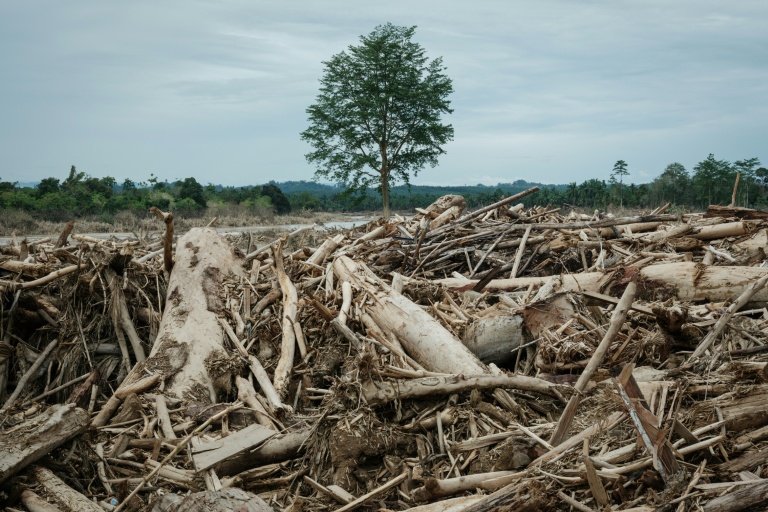
What made the disaster different from previous floods was the official acknowledgment that extreme weather alone was not to blame. Government investigators from the Bandung Institute of Technology found large logs carried by floodwaters that had been cut with machine saws rather than broken naturally—clear evidence that deforestation in upstream catchment areas had fatally weakened the landscape’s natural defences .
“We must protect our environment, our nature, and avoid illegal logging,” Prabowo told survivors at an evacuation post in Aceh Tamiang District in December. “I want all regional governments to enhance vigilance and step up environmental monitoring” .
A ‘polluter pays’ reckoning
The scale of the government’s response has been unprecedented. Beyond permit revocations, environment minister Hanif Faisol Nurofiq announced in January that six companies were being sued for more than 4.8 trillion rupiah (approximately US$366 million) in damages, seeking both fines and ecosystem restoration costs .
“Any company getting profits by damaging the ecosystem must be held fully responsible for restoring it,” Nurofiq said, affirming what he termed the “polluter pays” principle .
Environmental audits are now underway for more than 100 companies operating across the three affected provinces, spanning mining, energy, plantation and infrastructure sectors. Even licensed operations are not exempt. “Compliance with permits does not exempt a company if its operations violate environmental safeguards and result in serious damage,” Nurofiq warned .
Eight companies operating in and around the ecologically fragile Batang Toru ecosystem—home to the critically endangered Tapanuli orangutan, the world’s rarest great ape—have already been ordered to cease operations pending investigation .
Corruption and the roots of destruction
For Transparency International, the disaster confirms what research has long suggested: corruption has systematically undermined Indonesia’s environmental protections. The organisation found that nearly 60 percent of Indonesian parliament members are affiliated with businesses, including palm oil and mining interests that have benefited from permissive land policies .
“Evidence from multiple independent sources points to a clear pattern: large-scale deforestation has weakened the ability of Sumatra’s natural hydrological systems to absorb and regulate water, instead increasing runoff, sedimentation and the severity of floods during extreme rainfall,” said Maíra Martini, CEO of Transparency International .
The scale of forest loss is staggering. Between 2001 and 2024, Sumatra lost 4.4 million hectares of forest—an area larger than Switzerland . Greenpeace Indonesia reports that most river basins on the island have fallen into critical condition, with forest cover shrinking to less than 30 percent of the total area .
The Batang Toru river basin alone has lost 70,000 hectares of catchment area to deforestation since 1990. A further 94,000 hectares have been converted for industrial uses including mining, palm oil and power generation, contributing to an estimated 31.6 million tonnes of annual erosion .
The Tesso Nilo experiment
Nowhere are the complexities of Indonesia’s deforestation crisis more visible than in Tesso Nilo National Park in Riau province. Established in 2004 and expanded in 2009 to protect critical habitat for Sumatran elephants and tigers, the park has since lost 78 percent of its old-growth forest—largely to smallholder oil palm farms established by migrant families .
The government’s response has been radical. Since last year, officials working under a new nationwide forestry task force have begun relocating hundreds of farming families living inside the park, framing the policy around efforts to save Domang, a critically endangered Sumatran elephant calf .
“This activity will serve as a model for other locations in restoring national parks,” forestry minister Raja Juli Antoni said .
But the operation has proven fraught. When government officers first entered the park, they retreated after their forest command centre came under attack. The government responded by deploying 30 soldiers from a newly established military detachment, along with additional rangers and a rapid-reaction team .
Human rights concerns have also emerged. The National Commission on Human Rights raised alarms after many residents opposing relocation told investigators they had lived in the area for more than a decade and had not been offered compensation or resettlement options . By late November, the government reported seizing several thousand hectares of illegal palm oil plantations and razing encampments used by workers .
The seized land has been consolidated under a hastily assembled state-owned holding company, PT Agrinas Palma Nusantara, which has become, almost overnight, the world’s largest palm oil company .
Questions about what comes next
Despite the强硬 rhetoric, environmentalists remain cautious about whether the government’s actions will translate into lasting change.
“Revoking permits is not immediately a win,” said Panut Hadisiswoyo, a conservationist and orangutan specialist. “The idea of revoking should be to stop the devastation, but by continuing these operations, this means industry will continue in this vulnerable area” .
Conservationists have lobbied for a moratorium on development in Batang Toru, where Tapanuli orangutans suffered first habitat loss and then the flood disaster. Using satellite data and pre-existing population information, experts have calculated that nearly 60 animals may have been killed in what they termed an “extinction-level event” for the species, now estimated at only around 800 individuals .
Others worry that revoking permits and seizing operations has disrupted plans to audit and investigate companies to determine their precise responsibility for the disaster. And so far, the government has not outlined clear plans for forest recovery and environmental remediation .
“It’s not only revocation but it also has to include remediation, taking responsibility for the destruction,” said Timer Manurung, executive director of Indonesian environmental group Auriga Nusantara .
There are also questions about whether transferring operations to state control will improve environmental outcomes. “It’s a concern that the state-backed takeover may not guarantee better environmental practices, and that production may be prioritised over conservation,” said Amanda Hurowitz of Mighty Earth. “We have yet to see any plans” .
A ‘blessing in disguise’?
What gives some observers hope is a shift in public consciousness. The scale of the disaster—and the visibility of the government’s response—has dramatically raised awareness of deforestation’s consequences among ordinary Indonesians .
For Timer, this represents “a blessing in disguise”—a “very significant rising awareness” that could build lasting political support for environmental protection .
At the World Economic Forum, Prabowo framed the issue in stark terms, speaking of “an economic system driven by greed” and promising strengthened law enforcement to establish a more just economic order .
Whether those words translate into sustained action will determine not only the fate of Sumatra’s remaining forests, but the safety of the millions of Indonesians who live downstream from them.
The government has announced ambitious plans to reforest 12 million hectares nationwide . In Tesso Nilo, seedlings of rain tree, mahogany, garlic tree and even durian are now growing in the national park nursery. But officials’ greatest hope rests on ironwood, whose deep roots promise genuine resilience against erosion—a stark contrast to the oil palms whose shallow roots have left hillsides across Sumatra vulnerable to collapse .
For survivors still rebuilding their lives after the floods, the question is whether this reckoning will prove lasting—or merely another cycle of outrage followed by inaction until the next disaster strikes.






 Blog9 months ago
 Apps10 months ago
 Writing10 months ago
 News10 months ago
 Writing10 months ago
 Writing10 months ago
 Tech9 months ago
 Tech10 months ago